When your AC suddenly gives up the ghost on a blazing hot day, a blown fuse is one of the first things I check. It's a small, simple safety device with a big job: to sacrifice itself during an electrical surge to protect the expensive heart of your HVAC system. Figuring out why it blew is the key to getting your cool air back on for good.
Getting to the Bottom of a Blown AC Fuse

A blown fuse isn't just an annoyance; it's a warning sign. Your air conditioner is telling you that something is causing it to pull way too much electricity. Think of it as a red flag.
Now, if a fuse blows once during a massive thunderstorm, you might just chalk it up to a power surge. But if it keeps happening, you've got a bigger problem on your hands. Ignoring these repeated warnings is a recipe for a much more expensive repair bill down the line.
To help you troubleshoot, let's walk through the usual suspects when an AC fuse keeps blowing.
Common Causes of a Blown AC Fuse
The table below is a quick-glance guide I use to narrow down the possibilities when I'm in the field. It covers the most frequent culprits, what you'll likely notice, and the best way to handle it.
| Potential Cause | Common Symptoms | Recommended Action |
|---|---|---|
| Dirty Air Filter | Air feels weak coming from vents, AC runs non-stop but can't keep up | Pop in a new air filter. This is the easiest and most common fix. |
| Failing Capacitor | You hear humming or clicking from the outdoor unit, fan is slow to start | Time to call a pro. They can safely test and replace the capacitor. |
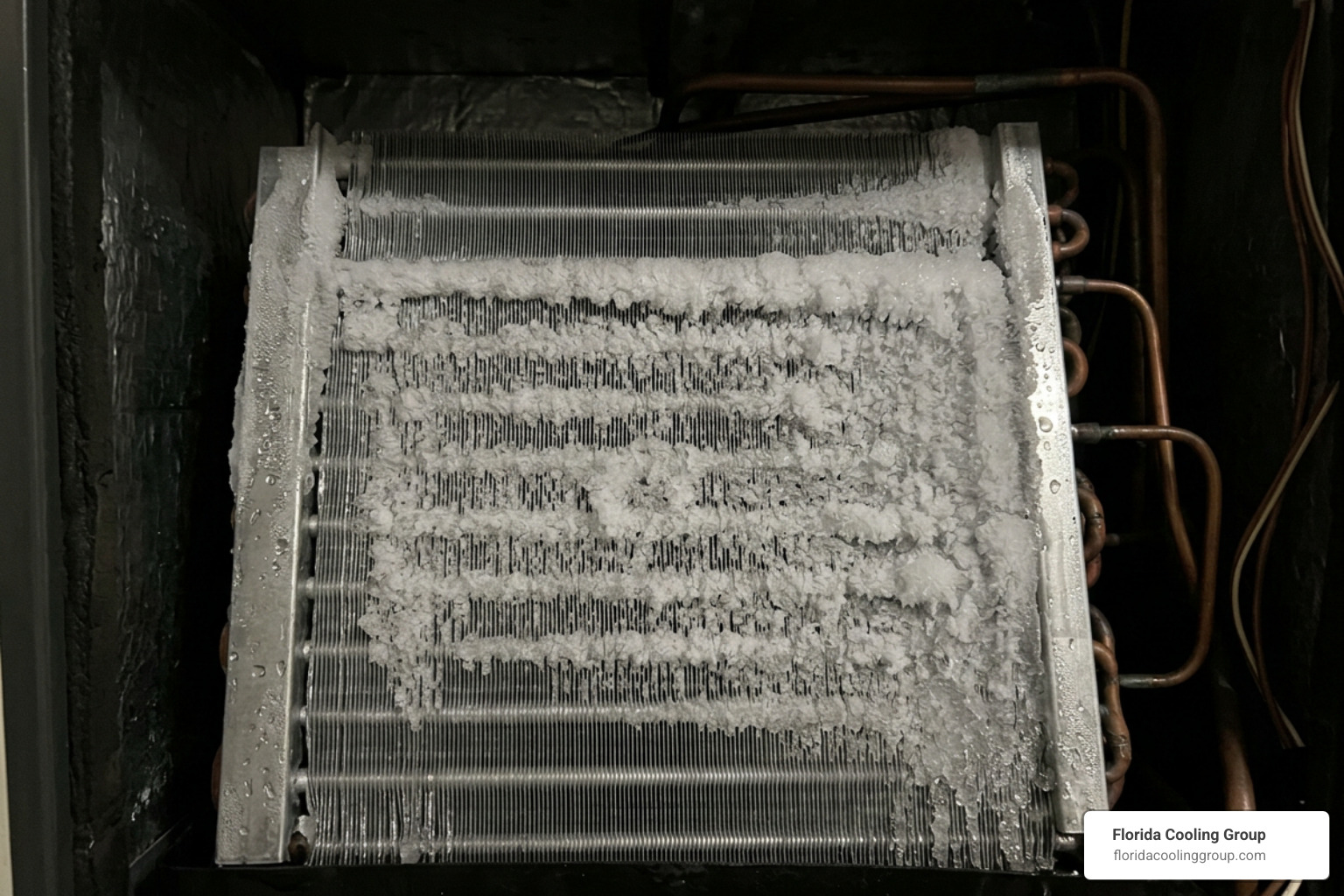
| Low Refrigerant | The AC is blowing warm air, or you see ice on the copper lines | This means there's a leak. A technician needs to fix it and recharge the system. |
| Faulty Compressor | Loud, clanking noises; the breaker trips often; AC refuses to start | This is a major component failure. Get an HVAC expert out to diagnose it. |
| Electrical Short | The new fuse blows the second you turn the AC on, maybe a burning smell | Kill the power immediately. This is a fire risk that needs professional attention. |
As you can see, the cause can range from something simple to a serious electrical hazard.
Deeper Electrical Faults
Sometimes, the problem isn't in the AC unit itself but in the wiring. Over the years, especially in our humid Florida climate, wiring can corrode and degrade. This breakdown can cause a short circuit—a sudden, massive jolt of electricity that will blow a fuse in an instant.
You might get a whiff of a faint burning smell or even see blackened wires near the outdoor disconnect box. These are serious red flags. To understand more about these scenarios, you can read up on what causes fuse box trips and how to fix them safely. Damaged wiring is a fire hazard, plain and simple, and it needs to be addressed by a professional right away.
Key Takeaway: A fuse that blows over and over is never a fluke. It's a clear sign of a deeper issue that could wreck your entire air conditioning system if you ignore it.
The good news is that many of these issues are preventable. Simple things, like changing a clogged filter, relieve the strain on your system that often leads to a blown fuse in the first place. Sticking to a good maintenance schedule, like this HVAC preventive maintenance checklist for 2025, is the best defense against these common problems.
Essential Safety Steps Before You Start
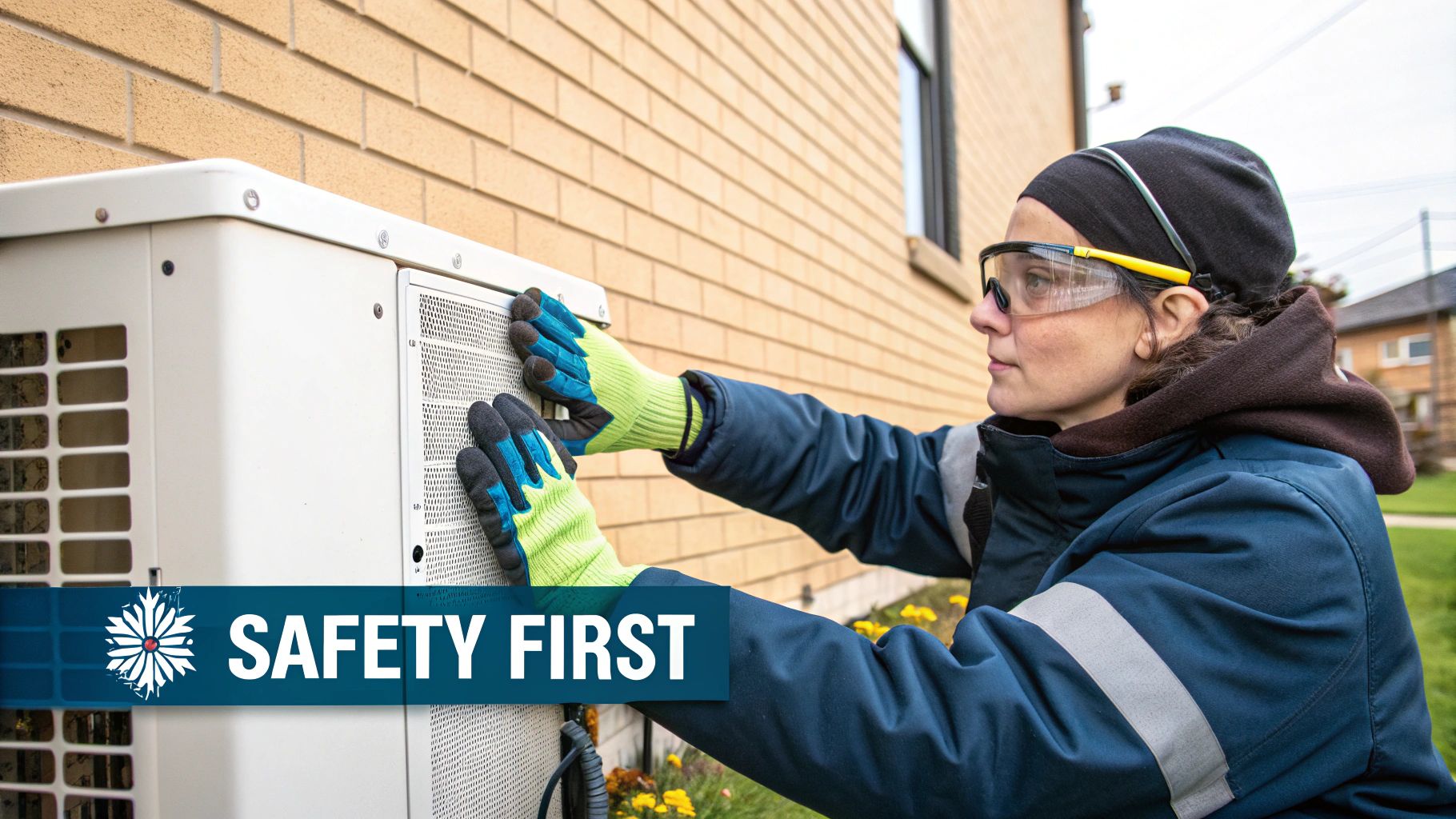
Alright, before you even think about cracking open that disconnect box, we need to have a serious talk about safety. This isn't like changing a lightbulb. Your air conditioner runs on a high-voltage circuit, and messing with it can be incredibly dangerous.
Getting this part wrong can lead to a severe electrical shock. So, let’s walk through the proper power-down procedure step-by-step. Think of it as a pre-flight checklist—skipping a single item is not an option. Our goal here is simple: make absolutely certain no electricity is flowing to that outdoor unit.
Powering Down the Right Way
First things first, head to your main electrical panel. You'll usually find it in the garage, basement, or a utility closet. Scan the labels for the breaker that controls your air conditioner. It might be labeled "AC," "HVAC," or "Condenser."
Most AC units use a double-pole breaker, which looks like two breaker switches fused together with a single handle. Grab it and flip it decisively to the "OFF" position. You should feel a solid click. That's the first cut-off point, but we're not done yet.
Now, go outside to your AC unit. Look for a smaller metal box mounted on the wall nearby—this is the disconnect box. Open the cover. Inside, you’ll typically find one of two things: a pull-out handle or a block holding the fuses.
- If you see a pull-out handle: Grab it firmly and pull it straight out toward you. Some older models are designed so you can flip the handle upside down and reinsert it, which clearly marks it as "OFF."
- If you have a fuse block: These are common in older homes. Just like the pull-out handle, you'll need to pull the entire block straight out.
Crucial Safety Check: I can't stress this enough: Never, ever assume the power is off just because you flipped a breaker. I've seen mislabeled panels and faulty breakers more times than I can count. Your multimeter is your best friend here.
Verifying Zero Power
Grab your multimeter and set it to measure AC voltage (look for the V~ or VAC symbol).
Carefully touch one probe to each of the terminals where the power lines come into the top of the disconnect box. An AC unit typically runs on 240 volts, so that's what you'd see if it were live. What you're looking for now is a big, fat zero.
Test every combination of terminals to be 100% sure. Only when that meter reads "0" across the board is it truly safe to proceed. This quick check takes all the guesswork out of the equation and confirms you have a completely de-energized work area.
Last step: put on your insulated gloves and safety glasses. Now you’re finally ready to take a look at those fuses.
Gathering the Right Tools for the Job

Before you even think about touching your AC unit, let’s talk tools. Showing up to any job unprepared is a recipe for frustration, and that’s especially true when dealing with electricity. The good news is you don't need a professional's full toolkit. But the few items you do need are absolutely essential for doing this safely and getting it right the first time.
Your Must-Have Tool Kit
Your most important piece of equipment, even more than the new fuse itself, is a good multimeter. This is your lifeline. It's the only way to be 100% sure the power is off before your hands go anywhere near the wiring. A multimeter also takes the guesswork out of the diagnosis—visual checks can be deceiving, but the meter will tell you definitively if a fuse is dead.
Here’s what else you should have ready:
- Insulated Screwdrivers: You’ll need these to open the disconnect box. The insulated handles are a crucial backup safety measure, protecting you from any stray current. It’s smart to have both flat-head and Phillips-head types on hand.
- Fuse Puller: This is a simple, non-conductive plastic tool for safely gripping and removing the old fuses. You can sometimes wiggle them out with your fingers, but why risk it? A fuse puller is the proper and safer way.
- Replacement Fuses: Of course, you need the new parts. But this is where things get serious—you absolutely must have an exact match.
Finding the Perfect Fuse Match
Grabbing the wrong fuse isn't just a mistake; it's a genuine fire hazard. Fuses are designed to be the weak link that protects your expensive AC equipment. Using the wrong one bypasses that protection entirely.
Most AC units use cartridge-style fuses, which have two critical ratings printed right on the side: voltage (V) and amperage (A). A common fuse, for instance, might be labeled "250V, 30A."
When buying a replacement, the amperage must be identical. Never, ever use a higher-amp fuse. It won't blow when it's supposed to, which can cook your compressor motor or start a fire. For voltage, the new fuse's rating should be equal to or greater than the old one, but never lower.
Here's a tip I've learned from years in the field: Just take a picture of the old fuse with your phone before you go to the hardware store. It's that simple. It completely eliminates any confusion and ensures you get the right part on your first trip.
Once you’ve got your tools and the correct replacement fuse, you're ready to get to work.
How to Inspect and Replace the AC Fuse
Alright, with the power safely off and your tools ready, it's time to get to the heart of the matter. We're not just swapping a part here; we're doing it the right way to ensure it's a lasting fix. I'll walk you through everything, from getting into the disconnect box to making sure your AC kicks back on.
First up, find the outdoor disconnect box. It's usually a grey metal box mounted on the wall right next to your condenser unit. Grab your insulated screwdriver and open the cover. Inside, you'll spot a block with a handle—that's the pull-out that holds the fuses. Get a good grip on the handle and pull it straight out. This is the final, physical break in the circuit, making it safe to work on.
This simple flowchart lays out the essential steps for a safe and successful fuse swap.
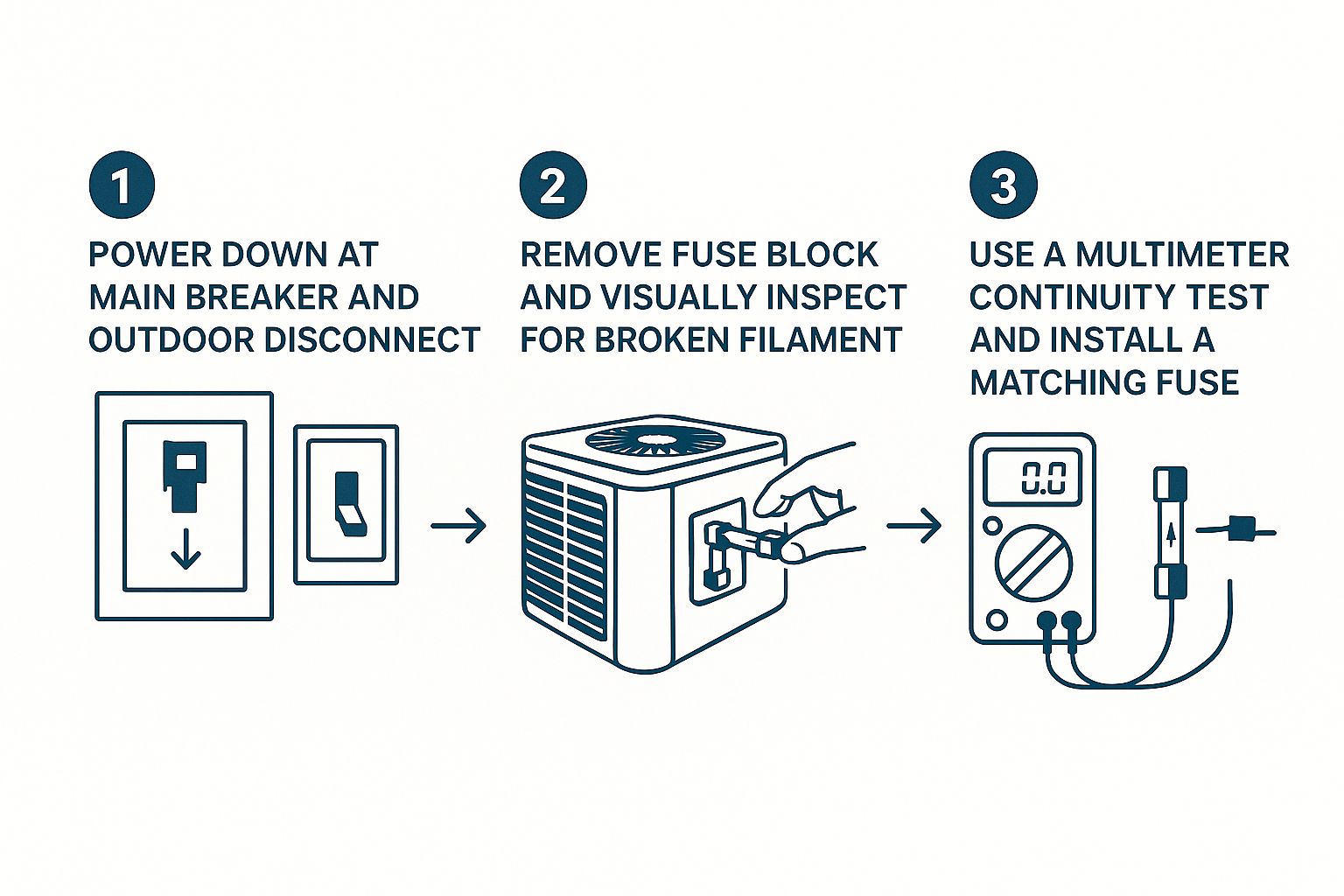
As you can see, checking that the circuit is dead with a multimeter isn't optional. It's a critical safety step between opening the box and touching any components.
Spotting a Blown Fuse
Now that you have the pull-out block in your hand, take a close look at the two cartridge fuses clipped into it. Sometimes, you can tell one is bad just by looking. If a fuse has a little glass window, you might see a broken or melted metal strip inside. It’s a dead giveaway.
Other visual clues that a fuse has given up the ghost include:
- A cloudy look: The glass might be hazy, dark, or discolored.
- Scorch marks: Look for black or brown spots on the glass or the metal caps.
- A loose filament: That tiny metal strip inside might look like it's rattling around.
But I've been fooled before. I've seen fuses that looked pristine but were completely dead electrically. So, while a quick visual check is a good start, it’s not proof. You have to test it to be 100% sure.
The Definitive Continuity Test
This is where your multimeter earns its keep. It takes all the guesswork out of the equation and tells you for certain if the fuse is the problem.
Switch your multimeter to the continuity setting. This is usually marked with a symbol that looks like sound waves ))), and it often shares a space on the dial with the resistance (Ω) setting. Before you do anything else, touch the two multimeter probes together. You should hear a solid beep. That sound confirms the meter is working and ready to find an unbroken electrical path.
Now, touch one probe to each metal end cap of the fuse.
If you hear a steady beep: The fuse is good. The circuit inside is complete, which means your AC problem lies elsewhere.
If you hear nothing: The fuse is blown. That internal filament is broken, creating a dead end for the electricity. This is the one you need to replace.
Make sure you test both fuses, even if one looks perfectly fine. It's not uncommon for just one of them to fail.
Installing the New Fuse Correctly
Once you’ve identified the bad fuse, it’s time to swap it out. Use your fuse puller—or just your fingers if you can get a good grip—and carefully pop the old fuse out of its clips on the pull-out block.
Now, take your new fuse (the one with the exact same ratings) and press it firmly into the clips. You should feel a solid snap as it seats into place. Don't leave it loose; a poor connection can cause arcing and heat, creating a whole new set of problems.
Before you close everything up, take a second to glance at the condenser unit itself. If the coils are caked in dirt and debris, it can restrict airflow and make the system work way too hard. That extra strain could be what caused the fuse to blow in the first place. For a step-by-step guide, check out our article on how to clean air conditioning coils.
With the new fuse securely in place, slide the pull-out block back into the disconnect box. It's usually designed to only fit one way for the "ON" position, so make sure it's oriented correctly. Now you can head back to your main electrical panel and flip the AC breaker back on. If all went well, you should hear your air conditioner power up.
What to Do When the New Fuse Blows Instantly
https://www.youtube.com/embed/_6eRHebRBlg
So, you did everything by the book. You shut off the power, pulled the old fuse, saw that it was clearly blown, and popped in the correct replacement. You slide the disconnect back into place, head to the breaker box, flip it on, and… pop. The new fuse is toast.
It’s an incredibly frustrating moment, but your AC unit is sending you a smoke signal. That immediate pop is a clear sign that you’re dealing with a serious underlying electrical problem, not just a simple bad fuse.
At this point, throwing another fuse at the problem is more than just a waste of money—it's genuinely dangerous. Every time you try to force power into that compromised circuit, you’re risking severe damage to expensive parts like your compressor. Even worse, you could be creating a serious fire hazard. This is where the DIY job stops and the real diagnostic work begins.
Finding the Real Electrical Gremlin
When a brand-new AC fuse blows the second power hits it, the cause is usually one of two major culprits: a direct short circuit or a seized-up motor.
A short circuit is exactly what it sounds like. Somewhere in the system, electricity has found a shortcut it was never meant to take, often due to frayed or damaged wiring insulation. This creates a massive, instantaneous surge of current that the fuse can't handle.
The other common offender is a seized motor, either in the compressor or the outdoor condenser fan. If the motor is physically locked and can't spin, it will try to draw an enormous amount of amperage to break free. This huge electrical demand is far beyond the fuse's rating, causing it to blow immediately to protect the rest of the unit.
You might have noticed a few other clues just before it all went wrong:
- A loud buzzing or humming noise coming from the outdoor unit as it tried to kick on.
- Visible signs of burnt, melted, or blackened wires inside the disconnect box or on the unit itself.
- A distinct, sharp smell of burning plastic or ozone near the condenser.
An instantly blown fuse is the system’s emergency brake. The electricity has hit a dead end, and that fuse is sacrificing itself to prevent a much bigger catastrophe.
Don't Ignore the Warning Signs
It's so tempting to think, "Maybe that new fuse was a dud," and just try one more. Please, resist that urge. You're dealing with a powerful electrical system, and trying to energize a shorted circuit is a recipe for disaster.
Fuses are there for a reason—they are the first line of defense against electrical surges and serious system faults. While it's true that external events like lightning storms can cause them to fail, an instant failure upon startup almost always points to an internal problem.
It's Time to Call in a Pro
This is the non-negotiable point where you need to put down the tools and call a licensed HVAC technician. An experienced pro won't just keep feeding fuses into the machine; they have specialized diagnostic equipment, like multimeters and megohmmeters, to safely trace the source of the short.
They can properly test motor windings, check capacitors, and inspect the high-voltage wiring to pinpoint exactly where the failure is. For a deeper dive into which AC problems are best left to the experts, check out our complete air conditioning troubleshooting guide. A professional can safely get to the bottom of it, whether it’s a grounded compressor, fried wiring, or a bad capacitor, and get your system back up and running without the guesswork.
Common Questions About Air Conditioner Fuses
When your AC fuse blows, it's natural to have questions. It can be a confusing situation, but getting a handle on a few key points can save you a lot of future headaches and help you understand your system a whole lot better.
Let's walk through some of the things people ask most often. Knowing the answers will not only help you fix the immediate issue but will also empower you to keep your HVAC system safe and healthy for the long haul.
Can I Use a Fuse with a Higher Amperage Rating?
I get this question a lot, and the answer is always a hard no. You absolutely cannot, and should not, use a fuse with a higher amperage rating. It's one of the more dangerous mistakes a homeowner can make.
Think about it this way: the fuse is a purpose-built weak link. It’s designed to sacrifice itself at a specific electrical current to protect the really expensive parts of your AC, like the compressor. If you swap a 30-amp fuse for a 35-amp one, you've just removed that critical protection.
A higher-rated fuse will let a dangerous amount of current surge through your system. That extra electricity can easily melt wires, fry the compressor motor, and even create a serious fire hazard. Always, without exception, replace a blown fuse with a new one that has the exact same amperage and voltage rating.
How Often Should an AC Fuse Need Replacing?
In a perfect world? Never. A blown fuse isn't a routine wear-and-tear item like your air filter. It's a clear warning sign that something else is wrong.
Now, if a massive thunderstorm rolls through and a power surge from a lightning strike takes out the fuse, that might just be a one-off fluke. But it should never be a regular thing.
If you’re replacing the fuse more than once in a cooling season, that’s a major red flag. It points to a deeper problem that isn't going away on its own—it could be a weak capacitor, a struggling fan motor, or a compressor nearing the end of its life. To keep your system in good shape and avoid these surprise failures, it's always a good idea to follow a comprehensive HVAC maintenance checklist.
What Is the Difference Between a Blown Fuse and a Tripped Breaker?
This is another great question, as they both seem to do the same thing. Fuses and circuit breakers are both safety devices designed to stop the flow of electricity when there's an overload or short circuit. The key difference is in how they do it.
-
A Fuse: This is a one-and-done device. Inside is a small metal filament designed to melt and break the circuit when the current gets too high. Once it blows, it's toast. You have to physically replace it with a new one. You'll typically find these in the outdoor disconnect box right next to your AC unit.
-
A Circuit Breaker: This is more like a reusable switch. When it detects an overload, an internal mechanism trips, flipping the switch to the "off" position and cutting the power. Once you've figured out what caused the problem, you can just flip it back on. You'll find these in your home's main electrical panel.
So, the simplest way to remember it is that a fuse is a disposable safety net, while a breaker is a resettable one.
If you're dealing with a recurring air conditioner blown fuse or any other HVAC issue in Palm Beach County, don't risk damaging your system. Contact the certified professionals at Florida Cooling Group for safe, reliable, and expert service. Schedule your appointment today!

Charlie Hadida is a senior HVAC technician and the SEO lead at Florida Cooling Group, with years of real-world experience diagnosing, repairing, and installing residential and commercial HVAC systems throughout Palm Beach and Broward County.
Unlike generic marketing content, Charlie’s work is grounded in on-site service experience — from troubleshooting electrical and airflow issues to overseeing full system replacements, crane lifts, and code-compliant installations. His technical background allows him to translate complex HVAC concepts into clear, accurate, and helpful information for homeowners, property managers, and business owners.
In addition to working in the field, Charlie leads Florida Cooling Group’s SEO and content strategy, ensuring that all service pages, guides, and educational resources reflect real conditions technicians encounter every day. This includes topics such as AC repair, preventive maintenance, system replacements, energy efficiency, permitting requirements, and South Florida–specific climate challenges.
Charlie plays an active role in shaping Florida Cooling Group’s service standards, maintenance programs, and long-term customer education efforts. His combined technical and SEO expertise helps bridge the gap between what customers search for online and what actually matters when servicing HVAC systems in Florida’s demanding environment.
Licensed HVAC Technician (Florida)
Residential & commercial HVAC experience
Hands-on system diagnostics, repairs, and installations
Experience with rooftop units, split systems, and package units
Local experience serving Palm Beach & Broward County
Areas of Expertise:
AC Repair & Troubleshooting
Preventive Maintenance & Service Agreements
HVAC System Replacements & Change-Outs
Commercial HVAC Systems
South Florida HVAC Codes & Permitting