Before you even think about buying a new air conditioner, the very first thing you need to do is figure out the right size. Using an air conditioner sizing calculator is a non-negotiable step that matches the system's power to what your home actually needs.
Getting this right from the start saves you from a world of headaches—sky-high energy bills, poor humidity control, and a system that dies years before it should. It’s the difference between a comfortable, efficient home and a really expensive mistake.
Why Accurate AC Sizing Is So Important
Picking the right size AC is probably one of the most critical decisions you'll make for your home's comfort and your bank account. There's a common myth floating around that bigger is always better when it comes to cooling. That couldn't be further from the truth. A unit that’s too powerful is just as bad as one that’s too weak.
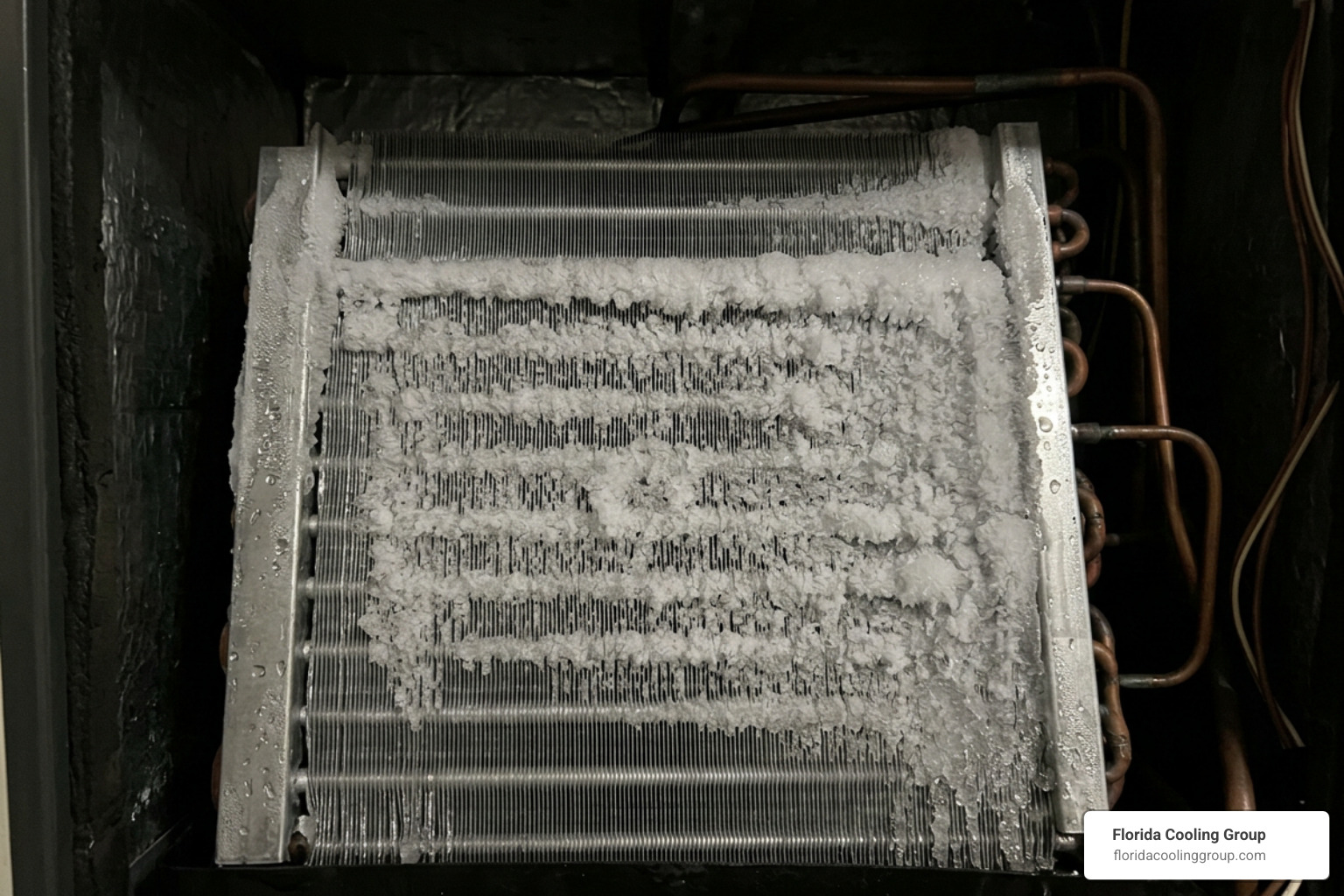
An oversized system blasts your home with cold air and cools it down way too fast. This is called short-cycling. Sounds great, right? Not really. It means the AC shuts off before it can do its other crucial job: pulling moisture out of the air. You're left with a room that feels cold but also sticky and damp.
That constant on-and-off jarring is also brutal on the compressor and other key parts. It leads to more breakdowns and can dramatically shorten the lifespan of your brand-new system.
The Pitfalls of an Undersized Unit
On the flip side, an undersized air conditioner brings its own set of problems. On a really hot day, this little unit will run and run and run, fighting a losing battle to hit the temperature you set on the thermostat. It just doesn't have the muscle to handle your home's heat load.
This nonstop operation causes a few major headaches:
- Skyrocketing Energy Bills: Your electricity use will go through the roof as the unit works overtime just to keep up.
- Uneven Cooling: You'll start noticing hot spots, especially in rooms that are far from the main unit.
- Excessive Wear and Tear: Running constantly without a break wears out motors, fans, and other components much faster than normal.
Finding the Goldilocks Zone
The truth is, properly sizing an AC involves a lot more than just the square footage of your house. We have to look at things like how good your insulation is, which way your windows face, and the climate you live in. Getting it wrong—too big or too small—invariably leads to higher energy costs and a shorter system lifespan.
When you nail the sizing, you get peak performance, great energy efficiency, and perfect humidity control. It’s the secret to keeping your home comfortable without wasting money. For any homeowner, learning how to improve AC efficiency begins with choosing the right size on day one. It's the foundation for a reliable system that will keep you cool for years.
Getting Beyond Square Footage: What Really Affects Your AC Size
Figuring out the right size for an air conditioner goes way beyond just the square footage of your house. Think of it like putting together a "heat profile" for your home. Every little detail adds up to the total amount of cooling you'll actually need. Sure, floor plans are the classic starting point, but the real magic happens when you account for all the sneaky ways heat gets in.
You'll often hear a rule of thumb, something like one ton of cooling for every 600-800 square feet. But honestly, that can be pretty misleading. A tiny 5,000 BTU window unit might be perfect for a 150-square-foot bedroom, but you can't just scale that math up for a whole house without getting into trouble.
This is exactly why a good air conditioner sizing calculator needs more to work with. Let's break down what really matters.
A Quick Sizing Reference
Before we dive deep, here's a general table to give you a ballpark idea. This is just a starting point based on square footage alone. We'll add the other critical factors in a bit.
General AC Sizing by Square Footage
| Area to Cool (Square Feet) | Required BTUs per Hour | Equivalent AC Tonnage |
|---|---|---|
| 600 – 1,000 | 18,000 | 1.5 Tons |
| 1,000 – 1,500 | 24,000 | 2 Tons |
| 1,500 – 2,000 | 30,000 | 2.5 Tons |
| 2,000 – 2,500 | 36,000 | 3 Tons |
| 2,500 – 3,000 | 42,000 | 3.5 Tons |
| 3,000+ | 48,000+ | 4+ Tons |
Remember, this is the baseline. Now, let's refine it with the details that make a real difference.
How Your Home's Design and Layout Play a Part
The physical structure of your home is a massive factor. High ceilings, for instance, dramatically increase the volume of air that needs to be cooled, even if the floor space seems manageable. A 1,500-square-foot home with 12-foot ceilings has 50% more air to cool than the same home with standard 8-foot ceilings. That’s a huge difference.
Windows are another big one—they're basically giant heat magnets.
- Which way do they face? A house with a wall of big, south-facing windows is going to bake in the afternoon sun, absorbing way more heat than one with mostly north-facing windows.
- What kind of windows are they? Old-school, single-pane windows might as well be open holes when it comes to heat transfer. Modern double-pane or triple-pane windows do a much better job of keeping the cool air in and the heat out.
- Is there any shade? Big trees, awnings, or even a covered porch can make a world of difference by blocking direct sunlight and cutting down on the heat pouring into your home.
Your Home's "Envelope": Insulation is Everything
Think of your home's insulation as its main line of defense against the summer heat. If you have poorly insulated walls or, worse, an under-insulated attic, your AC is going to be fighting a losing battle all day long. Heat naturally flows from hot to cold, and without a good thermal barrier, it will find its way inside.
An under-insulated attic is a classic energy-waster. It essentially bakes your home from the top down. Beefing up your attic insulation is hands-down one of the smartest investments you can make to lower your cooling costs.
Things like your roof also play a big role. Exploring energy-efficient roofing options can have a surprising impact on your home’s overall thermal performance. To get a clear picture of where your home is losing the fight against heat, it helps to do a thorough walkthrough. Our home energy audit checklist is a great place to start.
The Heat You Make Inside
Finally, you can't forget about all the heat generated inside the house. Every person, pet, and running appliance adds to the workload of your air conditioner.
- People: The more people you have living in the house, the more body heat you’re adding to the space.
- Appliances: Kitchens are heat factories. Ovens, stovetops, and even the drying cycle on your dishwasher pump a ton of heat into the air.
- Lights and Electronics: Old incandescent light bulbs get surprisingly hot. And if you have a home office with a couple of computers or a big-screen TV running, they're contributing to the heat load, too.
When you gather all this information, you're giving the air conditioner sizing calculator what it needs to go from a wild guess to an accurate, reliable recommendation for your home.
Alright, you've done the legwork and gathered all the details about your home's unique heat profile. Now comes the easy part: plugging it all into our interactive air conditioner sizing calculator.
This isn't your average, overly simple tool. It's designed to take all those factors we talked about and give you a cooling recommendation you can actually trust. Forget just using square footage—we’re going to get you a precise number. Let's walk through it together.
Plugging In Your Home's Details
You'll see a few fields to fill out. The more accurate you are here, the better your result will be. Every single input fine-tunes the final calculation.
- Total Square Footage to Cool: First up, the basics. Measure the length and width of every room you want to cool, multiply them to get the area for each, and then add them all together. For a pretty standard 1,800 sq. ft. house, you'd just pop in 1,800.
- Average Ceiling Height: Don't skip this one. Standard ceilings are usually 8 feet, but it's common to see 9-foot or even vaulted ceilings these days. That extra air volume makes a real difference and requires more cooling power. Just measure from floor to ceiling.
- Insulation Quality: Time for an honest assessment. Is your home older, with questionable insulation in the attic or walls? Be real and select "Poor." If it's a newer build that meets modern energy codes, "Good" is probably the right choice.
- Window Exposure: This is a huge heat source. Think about which direction your windows face. If you have a bunch of south or west-facing windows, they’re getting hammered by the most intense sun all afternoon. The calculator will adjust the BTU load based on how much direct sun your home gets.
- Climate Zone: Where you live matters—a lot. A house in humid Miami needs a much beefier AC unit than the exact same house in breezy Portland. Just pick the region that best matches your local weather.
This infographic gives you a quick visual breakdown of what the calculator is juggling to find your ideal size.
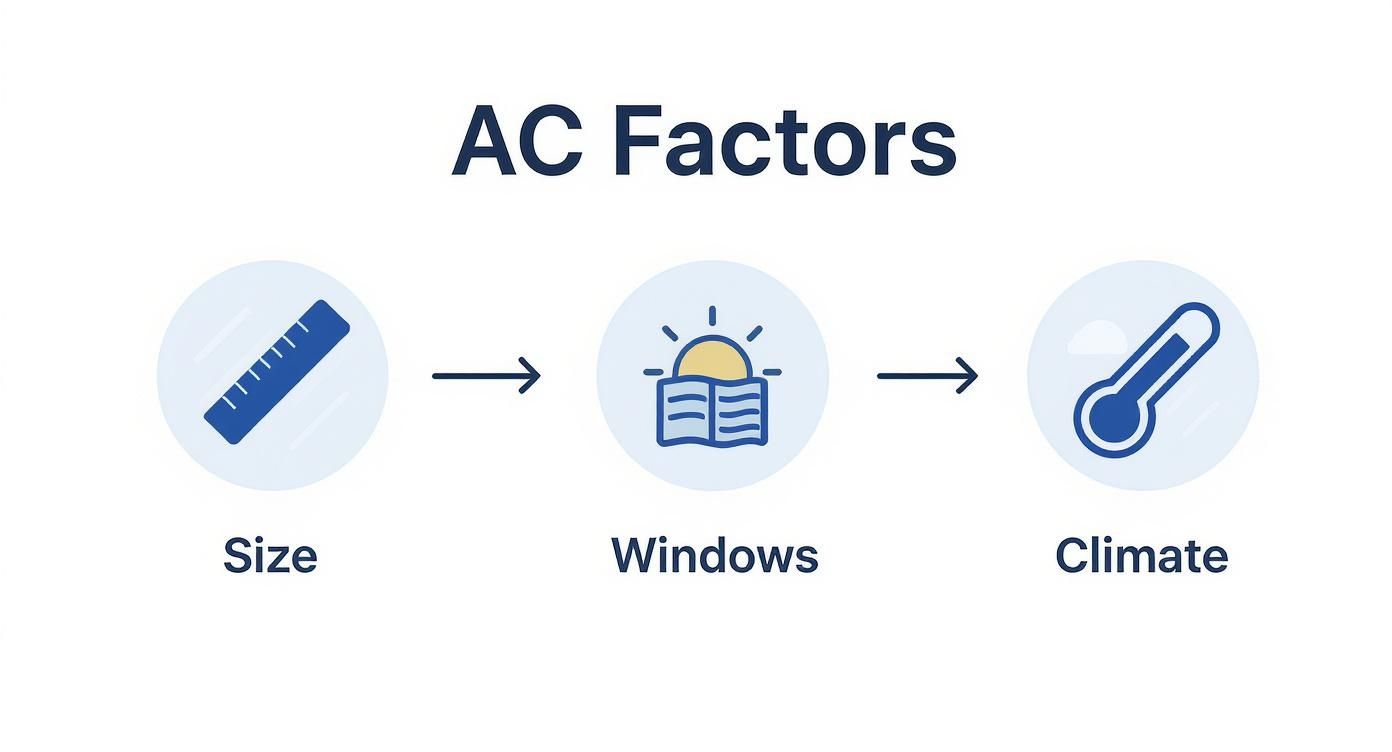
As you can see, getting the right size is all about balancing your home's physical footprint, how much sun it soaks up, and the climate you're up against.
A Real-World Sizing Example
Let's put this into practice. Imagine we're trying to size a system for a single-story, 1,800 sq. ft. home in a scorching hot place like Phoenix, Arizona.
Here’s our data:
- Square Footage: 1,800
- Ceiling Height: 9 feet
- Insulation: The house was built in the 90s, so the insulation is decent but not amazing. We'll go with "Average."
- Window Exposure: The entire back of the house gets blasted by the afternoon sun, with a big sliding glass door and three west-facing windows. That's a ton of heat gain.
- Climate Zone: Phoenix is a classic "Hot/Dry" climate.
Once we enter all that, the air conditioner sizing calculator spits out a recommendation of around 34,000 BTUs.
Now, if we had just used a generic square footage chart, it probably would have suggested a 30,000 BTU unit. But those high ceilings and west-facing windows add a heavy heat load, bumping up the requirement.
Key Takeaway: Using a detailed calculator prevents you from undersizing your unit. In our Phoenix example, just going by square footage would have meant installing a system that constantly struggles and can't keep up on the hottest days.
The whole point of our tool is to give you a reliable baseline. By taking a few minutes to input your home's specific details, you get a much clearer picture of what you actually need. That means you can walk into a conversation with an HVAC pro feeling confident and ready to make a smart decision.
How to Choose the Right AC Unit with Your Results
https://www.youtube.com/embed/h9d7KOPajOI
So, the calculator spit out a number for you. Let's say it's 28,500 BTUs. That's your target, but you're not going to find an AC unit with that exact number printed on the side. This is where a little bit of industry knowledge comes in handy.
Air conditioners come in standard sizes, and the general rule of thumb is to round up to the nearest available size. Manufacturers build these units in half-ton increments, which is 6,000 BTUs. So, for our 28,500 BTU requirement, the right move is to look for a 30,000 BTU system.
Just a word of caution: don't round up too much. If you jump from 28,500 BTUs all the way to a 36,000 BTU unit, you’ll run into those classic "oversizing" problems—short-cycling, poor humidity removal, and wasted energy. Stick to the next closest size.
Translating BTUs to Tons
When you talk to any HVAC pro, you'll hear them use the term "tons." It might sound like they're talking about weight, but it's really just a measure of cooling power. The conversion is straightforward.
One ton of cooling capacity is equal to 12,000 BTUs per hour.
Here’s a quick cheat sheet that makes it easy to switch between the two:
- 1.5 Tons: 18,000 BTUs
- 2.0 Tons: 24,000 BTUs
- 2.5 Tons: 30,000 BTUs
- 3.0 Tons: 36,000 BTUs
- 3.5 Tons: 42,000 BTUs
Following our example, that 30,000 BTU unit is what we in the business call a 2.5-ton system. Knowing both terms helps you shop around and have a clear conversation with your installer.
And making smart, efficient choices is more important than ever. The global air conditioning market is projected to skyrocket to $221.85 billion by 2032, which means technology and efficiency are going to keep getting better.
Looking Beyond the Size
Getting the right size is a huge first step, but it’s not the only thing that matters. Once you have your tonnage figured out, a few other factors will make a massive difference in your comfort and your monthly bills.
First up is the unit's efficiency, which is measured by its SEER2 (Seasonal Energy Efficiency Ratio 2) rating. Think of it like MPG for your car—a higher SEER2 number means the unit sips electricity instead of guzzling it. A high-efficiency model might cost a bit more at the outset, but the savings on your energy bills can be massive over the years. To really get into the weeds on this, our guide on ENERGY STAR® certified HVAC systems breaks down how they deliver serious long-term value.
Finally, you need to match the system type to your home's layout.
- Central Air: This is the go-to for cooling an entire house that already has ductwork.
- Ductless Mini-Splits: Fantastic for older homes without ducts, new additions, or for creating different temperature zones in your house.
- Window Units: A simple, budget-friendly option if you just need to cool a single room.
When you combine a precise BTU calculation with a high-efficiency unit that’s the right type for your space, you’ve got a winning combination for a cool, comfortable, and affordable home.
Common AC Sizing Mistakes You Need to Avoid
Even with the best online tools, a few common slip-ups can lead you straight to the wrong AC size. After years in the field, I’ve seen the same sizing mistakes trip up homeowners again and again. Think of this as your final quality check before you make a big investment.
One of the most frequent errors I see is simply replacing an old unit with a new one of the exact same size. It seems logical, but your home has likely changed over the last 10-15 years. Have you added new windows, beefed up your insulation, or even built an addition? Assuming the old size is still right ignores all those crucial updates.
Another huge one is the "bigger is better" mindset. This is a stubborn myth that leads to oversized systems. As we covered, an AC that's too powerful will constantly turn on and off—a process called short-cycling. It cools the air too fast to properly remove humidity, leading to unnecessary wear and an expensive mistake that leaves you feeling cool but uncomfortably clammy.
Underestimating Your Home's Heat Load
It's surprisingly easy to overlook subtle factors that dump a ton of heat into your home. People often forget to account for things that have changed over time, and they end up with an undersized unit that just can't keep up on those scorching summer days.
Be on the lookout for these common oversights:
- Old, Drafty Windows: Single-pane windows are basically giant holes for heat to pour through. If you haven't upgraded them, your cooling needs are way higher than a home with modern, efficient windows.
- New Home Additions: Did you convert a garage into a living space or add a sunroom? That new square footage absolutely must be included in your calculation.
- Lifestyle Changes: Has your family grown? Do more people work from home now, running heat-generating computers and monitors all day? Your internal heat load has definitely increased.
Your final check should be a simple gut check. Did you account for all the space you need to cool? Were you honest about your insulation and window quality? Answering these questions before you buy is the key to getting a perfect fit.
At the end of the day, using an air conditioner sizing calculator correctly means feeding it accurate, up-to-date information about your home as it is today, not as it was a decade ago.
Still Have Questions About Sizing Your AC?
Diving into the world of HVAC can feel a bit overwhelming, especially when you're trying to make sense of an air conditioner sizing calculator for the first time. Let's tackle some of the most common questions we get from homeowners, so you can feel more confident about finding the right fit.
"What happens if I just buy a bigger AC? Isn't bigger better?"
This is probably the number one misconception we run into, and it's a costly one. What happens if your AC is too big for your house? A unit that's too powerful will blast your home with cold air and shut off almost immediately. This is called short-cycling, and it's a huge problem.
Because the system doesn't run long enough, it never gets a chance to properly dehumidify the air. You're left with a room that feels cool but also damp and clammy. Worse yet, that constant on-and-off jarring is incredibly hard on the compressor. It leads to more breakdowns and can seriously shorten the lifespan of your brand-new system.
"Can I Trust an Online Calculator, or Do I Need a Pro?"
Another great question. Is an online tool really enough, or do you need to call someone out for a professional Manual J calculation? While our calculator gives a surprisingly accurate estimate for most typical homes, the Manual J is the undisputed industry gold standard for a reason—it's incredibly thorough.
A professional Manual J calculation goes way beyond square footage. The technician will analyze everything: the quality of your ductwork, air leakage rates, the specific R-value of your insulation, and even the thermal properties of your windows. It’s the only way to get a truly customized recommendation.
If you're putting in a whole new system, especially for a larger or uniquely designed home, investing in a professional load calculation is absolutely worth it. It guarantees you're getting the most efficient and effective performance from day one.
"How Much Does My Local Climate Really Matter?"
Homeowners often ask how much their location truly impacts the AC size they need. The short answer? A ton. Your geographic location is one of the most critical factors in the whole equation.
Think about it this way: a 2,000-square-foot home in hot, humid Houston is going to need a much beefier air conditioner than the exact same house in mild, dry Seattle. The system in Houston has to fight a constant battle against both intense heat and oppressive humidity, which takes a lot more cooling power. Our air conditioner sizing calculator is designed to account for this, adjusting its final BTU recommendation based on your region to ensure your unit can handle the peak summer weather right where you live.
Ready to make sure your home is perfectly cool and efficient? The certified technicians at Florida Cooling Group are here to help with professional sizing, installation, and maintenance. Contact us today for a consultation and experience the difference expert service makes.

Charlie Hadida is a senior HVAC technician and the SEO lead at Florida Cooling Group, with years of real-world experience diagnosing, repairing, and installing residential and commercial HVAC systems throughout Palm Beach and Broward County.
Unlike generic marketing content, Charlie’s work is grounded in on-site service experience — from troubleshooting electrical and airflow issues to overseeing full system replacements, crane lifts, and code-compliant installations. His technical background allows him to translate complex HVAC concepts into clear, accurate, and helpful information for homeowners, property managers, and business owners.
In addition to working in the field, Charlie leads Florida Cooling Group’s SEO and content strategy, ensuring that all service pages, guides, and educational resources reflect real conditions technicians encounter every day. This includes topics such as AC repair, preventive maintenance, system replacements, energy efficiency, permitting requirements, and South Florida–specific climate challenges.
Charlie plays an active role in shaping Florida Cooling Group’s service standards, maintenance programs, and long-term customer education efforts. His combined technical and SEO expertise helps bridge the gap between what customers search for online and what actually matters when servicing HVAC systems in Florida’s demanding environment.
Licensed HVAC Technician (Florida)
Residential & commercial HVAC experience
Hands-on system diagnostics, repairs, and installations
Experience with rooftop units, split systems, and package units
Local experience serving Palm Beach & Broward County
Areas of Expertise:
AC Repair & Troubleshooting
Preventive Maintenance & Service Agreements
HVAC System Replacements & Change-Outs
Commercial HVAC Systems
South Florida HVAC Codes & Permitting