The Ultimate DIY Guide to Changing Your Air Conditioner Fuse
What to Do When Your Air Conditioner Fuse Blows
Replace fuse for air conditioner is something most South Florida homeowners can handle themselves — and it’s often all that stands between you and a working AC on a sweltering day.
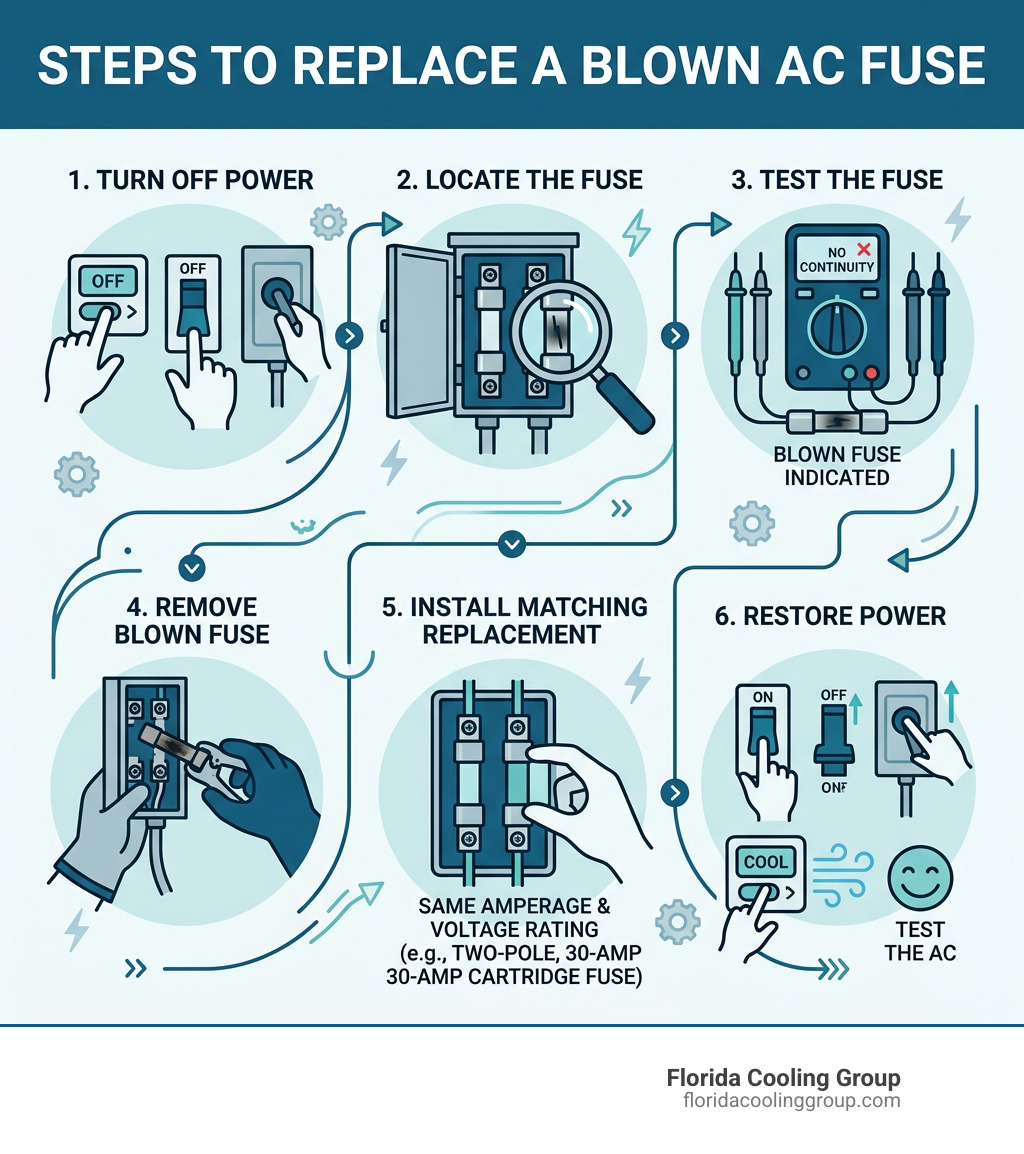
Here’s a quick overview of the steps:
- Turn off power at the thermostat, circuit breaker, and outdoor disconnect box
- Locate the fuse in the disconnect box (central AC) or on the control board (window unit)
- Test the fuse with a multimeter — no continuity means it’s blown
- Remove the blown fuse using a fuse puller or insulated pliers
- Install a matching replacement fuse with the same amperage and voltage rating
- Restore power and test the AC
Quick answer: Most central AC units use a two-pole, 30-amp cartridge fuse. Always replace with the exact same type and rating. Replacement fuses cost just $5–$20 at any hardware store.
Fuses are small, inexpensive components — but they do an important job. They act as a sacrificial barrier between a power surge or overload and your expensive compressor or circuit board. When too much current flows through the system, the fuse blows on purpose to cut the circuit and prevent serious damage.
The frustrating part? Your AC usually picks the hottest day of the year to stop working. That’s not a coincidence. High temperatures put extra stress on electrical components, making fuses and capacitors the most likely parts to fail during a summer heatwave.
The good news: a straightforward fuse replacement is an intermediate DIY task that takes 1–3 hours and costs a fraction of a professional service call ($5–$20 in parts vs. $75–$150 for a technician visit).
This guide walks you through the full process — safely and step by step.
I’m Charlie Hadida, a licensed HVAC technician and the SEO lead at Florida Cooling Group, with years of hands-on experience diagnosing and repairing residential and commercial AC systems across Palm Beach and Broward County — including countless calls where learning to replace fuse for air conditioner was all it took to get a home cool again. In this guide, I’ll share exactly what I do on the job so you can tackle this repair with confidence.
Understanding the Role and Signs of a Blown AC Fuse
In HVAC, we like to think of fuses as the “Secret Service agents” of your air conditioner. Their entire job is to “take the shot” to protect the more expensive components, like the compressor. By intentionally breaking the electrical circuit when an overload occurs, they prevent electrical fires and catastrophic equipment failure.
Fuses are designed with reactive elements—usually made of zinc, copper, or aluminum links. When the electrical current exceeds the fuse’s rated capacity, these metal links heat up and melt, physically severing the connection. To learn more about the specifics of this process, check out our guide on how to tell if an AC fuse is blown.
Common Symptoms of Electrical Failure
How do you know if you’re dealing with a blown fuse rather than a dead compressor or a thermostat glitch? Here are the red flags we see most often in the field:
- No Cooling Whatsoever: The most obvious sign. You set the thermostat to 72 degrees, but the temperature in the house keeps climbing.
- The “Hum of Death”: You might hear a faint humming sound coming from the outdoor unit, but the fan isn’t spinning. This often happens when one fuse in a pair has blown, leaving the unit with insufficient power to start the motor.
- Blank Thermostat Display: If your thermostat is powered by the HVAC system (and doesn’t have batteries), a blown fuse on the control board can cause the screen to go dark.
- Clicking Noises: You hear the system trying to engage, followed by a “click,” but then nothing happens.
- Fan Failure: The indoor blower might be moving air, but the outdoor condenser fan is stationary.
For a deeper dive into these warning signs, read more about blown AC fuses.
Visual vs. Technical Inspection
Sometimes, a fuse tells you it’s dead just by looking at it. In glass-style fuses, you might see shattered glass, a visible break in the internal wire, or dark burn marks. However, most modern central AC units use opaque cartridge fuses. You can’t see inside them, so a visual check isn’t enough.
This is where technical inspection comes in. We use a multimeter to check for continuity. Continuity simply means there is a continuous path for electricity to flow. If your multimeter shows “OL” (Open Loop) or doesn’t beep when touching the ends of the fuse, the internal link is melted, and the fuse must be replaced.

Preparation and Safety: Tools to Replace Fuse for Air Conditioner
Before you start poking around electrical boxes, we need to talk about safety. Your AC unit runs on 240 volts of electricity. That is more than enough to be fatal if you aren’t careful. If you are working on a window unit, the location and identification of window AC fuses might vary, but the safety rules remain the same.
Essential Safety Protocols
- Thermostat First: Turn the AC to “Off” at the thermostat.
- The Breaker Box: Go to your home’s main electrical panel and flip the breaker labeled “AC” or “Condenser” to the OFF position.
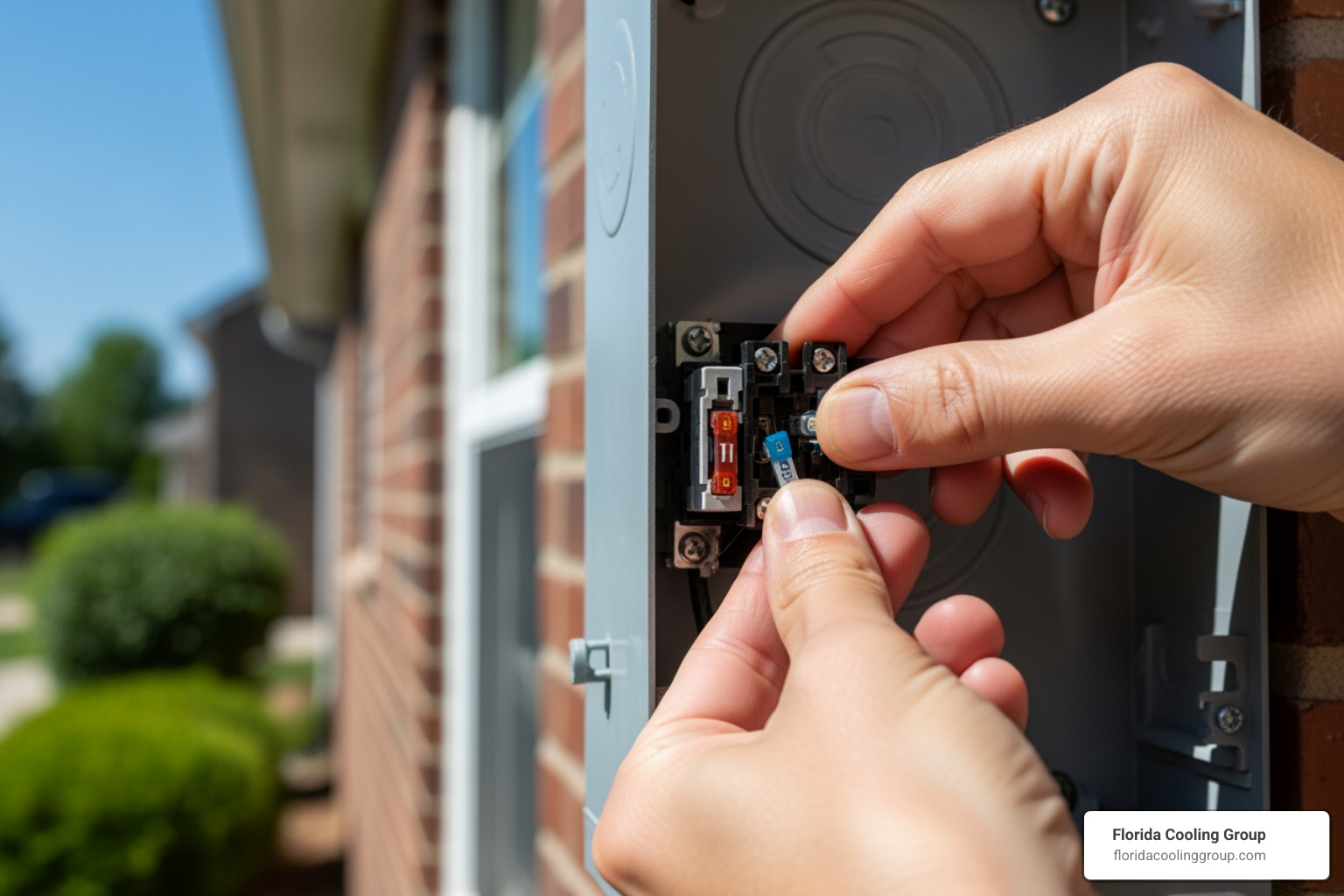
- The Disconnect Box: Locate the metal box mounted on the wall near your outdoor unit. Open it and pull out the T-handle or flip the internal switch to OFF.
- Verify with a Voltmeter: This is the most important step. Use a voltmeter to test the “Load” side (the wires going to the AC) and the “Line” side (the wires coming from the house). You should see a reading of zero volts. If you see 240V, the power is still live—stop immediately.
Tools You’ll Need:
- A multimeter or voltmeter
- A fuse puller (or pliers with heavily insulated handles)
- A screwdriver set (usually Phillips and Flathead)
- Work gloves and safety glasses
Selecting the Correct Replacement
You cannot simply grab any fuse off the shelf. Using the wrong size is a major fire hazard.
- Amperage Rating: Most residential units use 30-amp fuses, but some larger systems require up to 50 amps. Check the rating plate on the side of your outdoor unit for the “Max Fuse” or “MOCP” (Maximum Overcurrent Protection) rating.
- Type: Look for “Dual-element” or “Time-delay” fuses (often marked as ‘TR’). These are designed to handle the massive surge of electricity that occurs when the compressor first kicks on without blowing immediately.
- Voltage: Ensure the fuse is rated for at least 250V.
For more help finding the right part, see our tag for AC fuse replacement.
Step-by-Step Guide for Central Air Systems
Once you’ve confirmed the power is dead and you have your shiny new fuses ready, it’s time to get to work.
Testing and Removing the Old Fuse
Open the outdoor disconnect box. You will typically see a “pull-out” handle. Grip it firmly and pull it straight out. The fuses are usually clipped into the back of this handle or sitting inside the box itself.
Using your multimeter set to the Ohms (Ω) setting, touch the probes to both ends of the fuse. If the meter stays at “1” or “OL,” the fuse is blown. Use a plastic fuse puller to pop the old fuses out of their clips. Avoid using bare metal pliers, as they can slip and damage the copper lugs. While you’re in there, inspect the lugs (the metal slots the fuse sits in). If they look charred or feel loose, you might have a bigger electrical issue that requires troubleshooting the AC fuse.
Installing the New Component
- Snap it in: Place the new fuse into the pull-out handle or the clips. It should be a snug fit. If it’s loose, the heat generated by the poor connection will just blow the new fuse again.
- Re-insert the Handle: Push the T-handle back into the disconnect box. Note: Some handles can be inserted “upside down” to keep the circuit open—make sure the “ON” side is facing up.
- Restore Power: Flip the circuit breaker back on at the main panel.
- The Moment of Truth: Go inside and turn the thermostat to “Cool.” Give the system a few minutes (many units have a 5-minute delay timer).
If the unit starts up and stays running, congratulations! You’ve successfully handled a blown AC fuse.
Troubleshooting Window Units and Fuse Types
Window air conditioners are a bit different. They don’t usually have a giant disconnect box on the wall. Instead, they rely on internal fuses and specialized power cords.
Common Fuse Types for AC Units
| Fuse Type | Common Use | Appearance |
|---|---|---|
| Glass Tube (AGC) | Older window units / Control boards | Clear glass with a visible wire filament |
| Ceramic Slow-Blow | Modern window units / Compressors | Opaque white body; handles startup surges |
| Cartridge Fuse | Central AC disconnect boxes | Large cylindrical tubes (usually 2-3 inches long) |
| Thermal Fuse | Overheat protection in motors | Small, sensitive components that blow based on heat |
How to replace fuse for air conditioner in a Window Unit
Most modern window units use an LCDI (Leakage Current Detection and Interruption) cord. If the little green light on the plug is off, try pressing the “RESET” button. If that doesn’t work, you may need to replace the fuse for the air conditioner inside the unit.
To do this, you’ll need to unplug the unit and remove the front plastic panel. The fuse is typically located on the main control board, often encased in a small plastic cover. It’s usually a small glass or ceramic 3-15 amp fuse. Always replace it with the exact same amperage listed on the board.
When to replace fuse for air conditioner vs. Calling a Pro
We love a good DIY victory, but sometimes the fuse is just a symptom of a much scarier problem. You should stop what you’re doing and call Florida Cooling Group if:
- The new fuse blows immediately: This indicates a direct short circuit or a seized compressor.
- You smell burning: If the disconnect box smells like burnt plastic or “ozone,” you have melting wires.
- Visible smoke: Never attempt to replace a fuse if you see smoke.
- Repeated failures: If you are replacing the fuse every week, the system is drawing too much power, and you’re risking a house fire.
Why Your AC Keeps Blowing Fuses and How to Prevent It
If your AC keeps blowing fuses, it’s usually because it’s working too hard. Think of it like a person trying to breathe through a straw while running a marathon—eventually, something is going to give.
Common Underlying Causes
- Dirty Air Filters: This is the #1 cause. A clogged filter restricts airflow, forcing the blower motor to work overtime. This extra strain pulls more amps, which eventually pops the fuse.
- Dirty Condenser Coils: If the outdoor unit is covered in dirt or grass clippings, it can’t release heat. The system overheats, the pressure rises, and the compressor draws excessive current. You should thoroughly clean your unit at least once a year.
- Failing Capacitor: The capacitor is like a battery that gives the motor a kick-start. If it’s weak, the motor struggles to start, drawing a massive amount of electricity that blows the fuse.
- Low Refrigerant: When refrigerant is low, the system has to run longer and harder to reach the target temperature, leading to overheating.
Preventative Maintenance Tips
- Change Filters Monthly: In Florida, our ACs run almost 24/7. Don’t wait three months to change the filter.
- Clear the Area: Keep plants, weeds, and debris at least two feet away from your outdoor condenser.
- Annual Inspections: Have a pro check your electrical connections and refrigerant levels once a year. It’s much cheaper than a mid-August emergency repair.
- Surge Protectors: Install an HVAC-specific surge protector to shield your fuses from Florida’s frequent lightning strikes.
For more maintenance advice, check our tips on how to tell if an AC fuse is blown before the damage occurs.
Frequently Asked Questions about AC Fuses
Can I use a higher amp fuse if mine keeps blowing?
Absolutely not. This is incredibly dangerous. If you put a 40-amp fuse in a circuit designed for 30 amps, the fuse won’t blow when it should. Instead, the wires will overheat, melt their insulation, and likely start a fire inside your walls. Always stick to the manufacturer’s rating.
How much does it cost to replace an AC fuse?
If you do it yourself, the fuses cost between $5 and $20. If you call a professional, you can expect to pay between $75 and $150 for the service call and diagnostic, which usually includes the fuse replacement. While DIY is cheaper, a pro will also find why the fuse blew in the first place.
Why do AC fuses blow more often on hot days?
When it’s 95 degrees outside, your AC has to work much harder to move heat out of your home. High ambient temperatures cause electrical components to run hotter, increasing resistance. This combination of high demand and high heat is the perfect storm for electrical failure.
Conclusion
Learning how to replace fuse for air conditioner units is a valuable skill for any homeowner, especially here in Palm Beach and North Broward Counties. It can save you a bundle of money and hours of sweltering in the Florida humidity.
However, a fuse is a safety device. If it blows once, it might just be a random power surge or a particularly hot day. If it blows twice, your air conditioner is trying to tell you something is wrong. Don’t ignore the warning signs and risk damaging your expensive compressor.
At Florida Cooling Group, our licensed technicians are always ready to help. We stand by our FCG Guarantee, ensuring you get honest, reliable service every time. If your DIY fix hasn’t resolved the issue, or if you’d rather have a professional handle the high-voltage work, don’t hesitate to reach out.
Schedule Your Professional AC Repair Services Today!